Showing posts with label Health. Show all posts

Wednesday, 27 January 2016

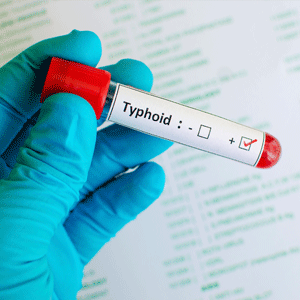
Typhoid outbreak feared in Harare

Harare - Zimbabwe has reportedly announced several cases of typhoid in the capital Harare, sparking fears of a major outbreak in the city.
According to The Herald, Harare City Health Director, Dr Prosper Chonzi, revealed that three cases of the disease had been reported in the last week.
The cases, confirmed in the areas of Glen Norah, Hopley and Hatfield, were of concern due to food being prepared in unhygienic conditions in certain parts.
Chonzi, however, called for calm among residents, saying that more than 30 cases of typhoid constitute an outbreak and that measures were being taken to curtail a further spread of the disease.
The announcement is the latest of several outbreaks to hit the capital in recent years.
According to IRIN News, a deadly outbreak was confirmed in Harare in January of 2012, with over 900 cases of the disease being reported across several weeks.
Chonzi urged residents to continue basic hygiene practices such as washing hands before meals and treating water at the point of use.
He also appealed to any citizens experiencing diarrhea to seek medical attention early in order to prevent the spread of the disease.

Thursday, 26 November 2015

Expatriate doctors begin equipment test-run at Ibom Specialist Hospital

Uyo—OPERATIONS will soon commence at the multi-billion naira Ibom Specialist Hospital, in Uyo, Akwa Ibom State, with the arrival of medical experts from outside the country.
Ibom Specialist Hospital
Conducting newsmen round the hospital facility, yesterday, Commissioner for Health, Dr. Dominic Ukpong, accompanied by the expatriates, said operations would start immediately after the test-run of the equipment.
Ukpong explained that many reasons such as taking care of practising license for the expatriate medical team, immigration and some logistic, delayed the take-off of operations at the hospital after it was commissioned in May, 2015 by the immediate past administration.
He said: “Those were some of the things we needed to put in place and now we have met those requirements that is why we are starting. As you can see, this is a multi-purpose specialist hospital with different sections. Doctors in charge of the different sections are here to test-run the medical equipment.”
“This is to ensure that the medical equipments are in order. And as soon as they complete that we will commence operations. But I can assure you that the equipment we have here are the latest and second to none in Africa.”
The Commissioner said that he was optimistic that with the capacities the medical experts recruited and the quality services that will be offered that the hospital will in a short time become a reference point in the whole of Africa.

Friday, 20 November 2015

Guinea Begins Countdown to End of Ebola

Guinea Begins Countdown to End of Ebola After Nearly 2 Years

Authorities have started the countdown to the end of Ebola in Guinea, the last country still reporting cases after nearly two years and more than 11,000 deaths worldwide, health officials said Tuesday.
The patient's recovery and the lack of new cases raise hopes that Guinea — and the world — could end Ebola transmission before the end of the year. Guinea must still go 42 days without any new cases and after that must maintain a period of heightened surveillance.
Health officials performed a second test Monday on a baby whose mother had died in October from Ebola.
"The baby is negative and so Guinea today is without a single Ebola patient," said Fode Tass Sylla, spokesman for Guinea's national Ebola response taskforce. "We are crossing our fingers and praying that nothing will happen over the next 42 days so that we can celebrate Guinea without Ebola."
The World Health Organization declares that Ebola disease transmission has ended when the country goes through two incubation periods — 21 days each — without a new case emerging.
The other two countries hardest hit by the virus — Sierra Leone and Liberia — already have reached that benchmark. But authorities in Guinea said they continued to face resistance in fearful communities, where people initially blamed international health workers for bringing the virus to their region.
Many preferred to bring their sick to traditional healers instead of Ebola clinics and often buried the dead without conforming to the health rules that were designed to prevent mourners from being infected by corpses.